Best Tri-Fuel Generator for Home (2026)
Key Takeaways
- Multi-Fuel Flexibility: A tri-fuel generator operates on gasoline, liquid propane (LPG), and natural gas (NG), providing three distinct fuel pathways during power grid interruptions.
- Continuous Operation via Natural Gas: Connecting directly to a residential natural gas line enables extended runtime without manual refueling stops, fuel handling, or reliance on gas station availability during localized emergencies.
- Output Derating Considerations: Energy density varies across fuel types. Gasoline provides the highest electrical output, propane delivers approximately 10% to 15% less power than gasoline, and natural gas produces approximately 15% to 30% less output than gasoline.
- Power Quality for Sensitive Electronics: Inverter tri-fuel generators utilize microprocessor controls to maintain Total Harmonic Distortion (THD) below 1.5%, matching utility grid tolerances required for microprocessors, medical equipment, and variable-speed appliances.
- Safe Grid Isolation: Connecting a portable generator to a residential load center requires a mechanical interlock kit or a manual transfer switch to prevent electrical backfeeding into the utility grid.

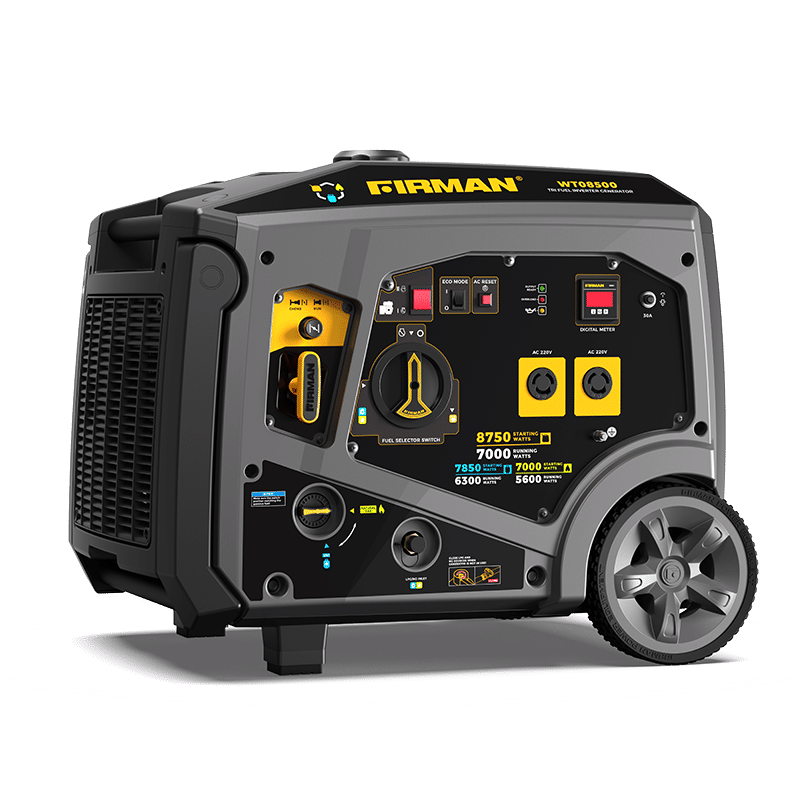
Best Tri-Fuel Generator for Home -- FIRMAN WT08500 Tri-Fuel Inverter Generator
FIRMAN WT08500 is a portable tri-fuel inverter generator designed for whole-home emergency backup, remote job applications, and sensitive home electronics.
| FIRMAN WT08500 Technical Profile | |
| Gasoline Output | 6,850 W Starting / 5,500 W Running |
| Propane (LPG) Output | 6,250 W Starting / 5,000 W Running |
| Natural Gas (NG) Output | 5,600 W Starting / 4,500 W Running |
| Engine Architecture | 322 cc 4-Stroke Single-Cylinder OHV (Max-Pro Series) |
| Alternator / Power Form | Pure Sine Wave Inverter (THD < 1.5%) |
| Frequency & Phase | 50 Hz / 60 Hz; Single Phase (1.0 COSΦ |
| Sound Attenuation | 69 dB(A) at 7 meters |
| Fuel Tank Capacity | 20 L (Gasoline) |
| Throttle Efficiency | Smart ECO Mode (reduces fuel consumption by ~25%) |
| Starting System | Electric Start (battery included) / Recoil Backup |
| Unit Dry Weight | 59.4 kg |
- On-the-Fly Fuel Switching: Features quick-connect couplings and a multi-channel fuel management valve, enabling switches between fuel sources without turning off the generator.
- Clean Inverter Waveform: Microprocessor regulation keeps harmonic distortion low, protecting solid-state electronics, smart TVs, and medical hardware such as CPAP machines.
- Sound-Dampening Enclosure: Combines a soundproof canopy, two-stage air intake baffles, and an industrial high-frequency muffler to achieve an operating noise level of 69 dB(A) at 7 meters.
What Is a Tri-Fuel Generator and How Does It Function?
A tri-fuel generator is an engine-driven electrical power source engineered to combust three distinct fuel types: standard unleaded gasoline, liquid propane gas (LPG), and utility natural gas (NG).
Standard single-fuel units operate solely on gasoline, while dual-fuel generators add an LPG connection. A tri-fuel generator incorporates:
- Multi-Channel Fuel Delivery: A specialized carburetor coupled with a low-pressure demand regulator designed to accept dry gaseous fuels alongside liquid fuel.
- Fuel Metering Assembly: Internal passages calibrated for the differing volumetric flow requirements of natural gas compared to liquid propane.
- External Fuel Selector Interface: A rotary control switch or quick-connect block allowing users to toggle between liquid fuel and gaseous supply lines.
Gasoline vs. LPG vs. NG: Operating Fuel Compare
Selecting the operating fuel involves tradeoffs among peak power output, fuel shelf life, on-site storage logistics, and engine maintenance intervals.
| Feature Parameter | Gasoline | Liquid Propane (LPG) | Natural Gas (NG) |
| Output Capability (Relative) | Baseline maximum (100%) | ~10% to 15% reduction vs. Gas | ~15% to 30% reduction vs. Gas |
| WT08500 Rated Wattage | 6,850 W Start / 5,500 W Run | 6,250 W Start / 5,000 W Run | 5,600 W Start / 4,500 W Run |
| Fuel Shelf Life | ~30 days without fuel stabilizer | Indefinite (stored in steel tanks) | Continuous utility line supply |
| Storage Requirement | Approved portable fuel cans | 20 lb, 40 lb, or 100 lb cylinders | No storage tanks required |
| Refueling Mechanism | Manual pour into tank | Manual cylinder swap | Direct connection to gas meter |
| Combustion Cleanliness | Leaves gum and carbon deposits | Clean burning, minimal carbon | Cleanest burning, zero gumming |
| Supply Reliability in Outages | Susceptible to gas station closures | Limited by on-site tank count | Remained pressurized during storms |
*Source: AFDC -- Fuel Properties Comparison
1. Gasoline
Advantages: Delivers the highest thermal energy density, translating to maximum starting and running wattages. Fuel is accessible during normal non-emergency conditions.
Limitations: Standard gasoline begins degrading within approximately 30 days as volatile compounds evaporate, forming varnish that obstructs internal carburetor jets. It requires regular stabilizer treatment or draining before seasonal storage.
2. Liquid Propane (LPG)
Advantages: Propane does not degrade over time, making it suitable for long-term storage in sealed cylinders. It burns with lower carbon emissions than gasoline and avoids carburetor fouling.
Limitations: Pressurized cylinders are heavy to transport. The boiling point of liquid propane (-42°C / -44°F) and container vaporization limits reduce regulator gas delivery during extended freezing weather.
3. Natural Gas
Advantages: Draws fuel directly from an existing residential utility line, providing continuous runtime without stopping to refuel. It avoids fuel shelf-life limitations, fuel odor, and fuel spillage.
Limitations: Due to its lower energy density (approximately 1,000 BTU per cubic foot compared to propane's 2,500 BTU per cubic foot), natural gas yields the lowest electrical output of the three fuels, requiring extra wattage margin during system planning.
4 Advantages of a Tri-Fuel Inverter Generator for Home Backup
1. Redundant Emergency Fuel Strategy
Severe weather events frequently disrupt local commercial supply chains. Flooding, ice storms, and extended blackout conditions can leave retail gas stations without pumping power or depleted of inventory.
Having three fuel options allows homeowners to switch to propane cylinders or an active natural gas utility drop when gasoline is unavailable.
2. Extended Runtime During Protracted Outages
Relying on liquid gasoline requires storing multiple safety cans to sustain operation over several days.
Operating a generator connected to a residential natural gas stub provides continuous power for days or weeks, with downtime limited to engine cool-down periods for periodic engine oil level checks.
3. Lower Engine Maintenance Overhead
Gaseous fuels enter the engine in a vapor phase rather than as an atomized liquid spray. This prevents fuel washing against cylinder walls, reduces lubricating oil dilution, and decreases carbon buildup on the spark plug and exhaust valve seats. The engine avoids the carburetor gumming issues that cause hard starting after extended periods of inactivity.
4. Pure Sine Wave Power for Modern Household Hardware
Conventional portable generators utilize standard rotating field alternators that can produce Total Harmonic Distortion (THD) figures between 5% and 15%. High THD levels cause excess heat in electric motor windings and can lead to logic board malfunctions in modern appliances.
Inverter models, such as the FIRMAN WT08500, electronically synthesize AC power through an inverter module to achieve a low THD, matching utility power quality for:
- Furnace control boards and electronic blower motors
- Inverter-driven refrigerators and freezers
- Medical CPAP and oxygen concentrator devices
- Laptops, desktop computers, and home internet routers
Home Generator Sizing Guide: How to Choose Tri-Fuel Generator
Selecting the appropriate tri-fuel generator setup involves calculating appliance power loads, selecting connection hardware, and verifying household gas utility plumbing.
Step 1: Calculate Home Power Requirements
Residential electrical loads are divided into continuous running wattage and transient starting wattage:
- Running Watts: The baseline power required to keep an electrical device operating after startup.
- Starting (Surge) Watts: The brief surge power consumed by electric motors (e.g., compressor pumps in refrigerators, air conditioners, or well pumps) during initial rotation.
| Appliance Description | Running Watts (W) | Starting Surge (W) |
| Refrigerator / Freezer | 700 | 2,200 |
| Sump Pump (1/2 HP) | 1,050 | 2,200 |
| Microwave Oven | 1,000 | 1,000 |
| Gas Furnace Fan Blower | 800 | 2,300 |
| LED Lighting Circuits (10 bulbs) | 100 | 100 |
| Portable Box Fan / Space Fan | 120 | 120 |
| Laptop & Wi-Fi Router Base | 150 | 150 |
| Total Combined Load | 3,920 W Running | 5,170 W Peak Surge |
*Note: Peak surge is calculated by adding the single largest starting surge (Gas Furnace Blower: 2,300 W) to the total operational running load of the remaining appliances.
Step 2: Account for Fuel Derating
When sizing a system to run on natural gas, calculate equipment capacities using the generator's natural gas ratings rather than its headline gasoline wattage.
For instance, the FIRMAN WT08500 provides 6,850 W starting and 5,500 W running on gasoline, but operates at 5,600 W starting and 4,500 W running when connected to natural gas. Sizing the household load to remain within the 4,500 W continuous envelope ensures stable operation on utility gas lines.
Step 3: Natural Gas Plumbing and Line Sizing
Connecting a portable tri-fuel generator to a residential gas system requires adequate gas volume and pressure:
- Operating Pressure: Small engine gaseous carburetors generally require a supply pressure between 7 and 11 inches of water column (in. w.c.), equivalent to approximately 0.25 to 0.40 psi.
- Hose Sizing: Use an approved low-pressure flexible gas line with an internal diameter of 1/2-inch or 3/4-inch depending on the distance from the utility gas meter. Running undersized 3/8-inch hoses over lengths greater than 10 feet restricts fuel volume, causing engine surging or inability to support electrical loads.
- Plumbing Connection: A dedicated shut-off valve, sediment trap, and quick-disconnect fitting installed by a licensed gas technician ensures a leak-tested fuel connection point.
Step 4: Safe Electrical Interconnection
Connecting a portable generator to home circuits requires mechanical isolation from the electrical utility grid:
- Manual Transfer Switch: A dedicated sub-panel containing individual circuit toggles wired to specific household loads (such as furnace, refrigeration, water pump, and primary lighting).
- Breaker Interlock Kit: A mechanical plate installed on the main breaker panel that prevents the main utility breaker and the generator backfeed breaker from being switched on simultaneously.
- Receptacle Interface: A NEMA L14-30 inlet box installed on the home exterior allows connection using an industrial 4-prong generator cord, providing both 120 V and 240 V service across panel legs. Connecting a generator directly to a domestic wall socket ("backfeeding") violates electrical codes and introduces electrocution hazards for utility line crews.
Frequently Asked Questions (FAQ)
Why does a generator produce less wattage on natural gas than on gasoline?
Power output is determined by the volumetric energy density of the fuel air-charge entering the combustion chamber. Liquid gasoline produces roughly 114,000 BTU per gallon, whereas natural gas contains approximately 1,000 BTU per cubic foot at standard atmospheric pressure.
Since gaseous fuels displace a portion of incoming combustion air within the engine intake tract, the engine draws less total chemical energy per intake stroke.
Can a tri-fuel generator switch fuel types while the engine is running?
Units equipped with dual gaseous regulators and multi-port carburetors, including the FIRMAN WT08500, allow fuel switching without shutting down the engine.
When switching between LPG and natural gas, opening the secondary fuel valve prior to closing the primary fuel supply maintains engine rotation without interruption. When transitioning from gasoline to gaseous fuels, allow the carburetor bowl to clear residual liquid fuel to prevent engine flooding.
What diameter natural gas hose should be used for a portable generator?
For generators operating within the 5,000 W to 8,000 W range, a 1/2-inch internal diameter (ID) flexible hose is standard for runs up to 10 feet. For hose runs between 10 and 25 feet, or when operating at gas line pressures below 7 inches of water column, a 3/4-inch ID hose is recommended to prevent gas volume restriction during motor startup surges.
Is an inverter generator necessary for home backup?
Standard non-inverter generators can run basic resistive and inductive appliances, including space heaters, basic water pumps, and older incandescent lighting.
However, modern domestic appliances frequently include microprocessor-controlled circuit boards, variable-frequency motors, and digital interfaces. An inverter generator maintaining low Total Harmonic Distortion (THD) prevents microprocessor timing errors, excessive motor heating, and unintended shutdown of sensitive household electronics.
How should fuel be managed when storing a tri-fuel generator?
If operating on gasoline, run the engine with the fuel shut-off valve closed until the carburetor runs completely dry, or add an approved fuel stabilizer if fuel will remain in the tank past 30 days.
If operating exclusively on propane or natural gas, close the supply valve and allow the engine to consume residual gas in the lines. Gaseous fuels leave no deposits in the fuel passages during seasonal storage.
Conclusion
Review the FIRMAN Residential Power Solutions and contact us for more power solutions.
Reference
- AFDC -- Fuel Properties Comparison
- TORO – Fuel Fact
Where to Find Our Social Media
for the Latest Updates?
Follow us on Facebook and Instagram to stay updating more information on our latest promotion activities and news #SUMECFIRMANNG #FORQUALITYLIVING


What can we
help you find today?