- Preparing for Extreme Weathers:
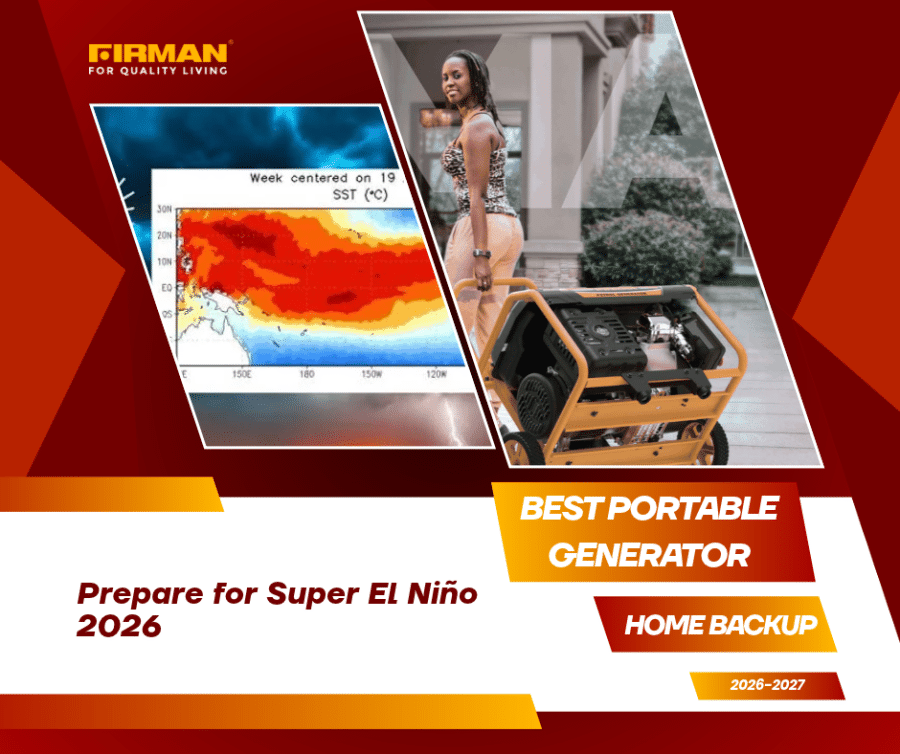
WhileNOAA and the WMO report that a strong El Niño pattern is influencing late-2026 and early-2027 seasonal weather, which which increasesincreasingthe probability of heavier precipitation and storm activity across regions like the Southern and Eastern United States. Discussion on home backup planning is heatedheating up. - Best Portable Generator for Essential Home Backup & Sensitive Electronics: FIRMAN FIG5880 (Open-Frame Inverter GeneratorOPEN Fi Series). Combines 3,500W running power with 6,000W starting surge capacity, pure sine wave output (THD below 1.5%), a 29 kg lightweight frame, and up to 18 hours of runtime at 25% load on a 12L petrol tank.
- Petrol Inverter vs. Battery Station: Portable battery power stations work well for short 2-to-6-hour outages powering phones and routers, whereas a fuel-efficient petrol inverter generator like the FIG5880 is designed for multi-day grid disruptions where refrigeration, fans, lighting, and high-surge compressor loads must keep running.
The National Oceanic and Atmospheric Administration (NOAA) October 2026 Winter Outlook and World Meteorological Organization (WMO) seasonal updates indicate that strong Pacific warming is driving wetter-than-average conditions and heightened storm potential across parts of North America and global coastal regions through early 2027.
For homeowners, the practical buying question is much closer to home: if grid electricity becomes unavailable for 12 to 48 hours, which appliances must stay running, and what type of backup generator can support them safely and affordably? No worries, this guide might give you some hints.
Quick Comparison: Which Home Backup Option Fits Your Outage Scenario?
Before selecting specific hardware, match your primary household concern to the appropriate backup power category:
| What Worries You Most During an Outage? | Recommended Backup Category | Core Capability & Runtime Profile | Key Buying Question to Ask |
| Food spoilage, warm bedrooms, and losing power for 12+ hours to several days | Petrol Open-Frame Inverter Generator (e.g., FIRMAN FIG5880) | 3,500W running / 6,000W starting; runs 11–18 hours per 12L tank (at 50%–25% load) with <1.5% THD clean power | Does it handle your compressor startup surges, and do you have safe outdoor operating space and petrol storage? |
| Losing phone charging, Wi-Fi routers, or basic LED lights for a few hours | Portable Battery Power Station (e.g., Li-Ion Power Bank) | Silent indoor operation; limited to the watt-hours stored in the internal battery (typically 1–3 kWh) | How many hours will its usable stored energy last once your refrigerator is plugged in? |
| Extended off-grid living or cutting daily utility bills alongside backup | Hybrid Solar Inverter + Li-Ion Home Storage (e.g., FIRMAN HESS) | Zero-emission indoor storage paired with rooftop or portable solar panels | Is your daily sunlight exposure and solar array wattage sufficient to recharge the battery bank? |
| Powering an entire large house automatically (central HVAC, electric stove, well pump) | Permanent Standby Generator (Diesel or Natural Gas with ATS) | 10 kVA – 25+ kVA fixed outdoor installation with automatic transfer switch | Does your budget cover both the unit cost and professional electrical/plumbing installation? |
Product Spotlight: Why the FIRMAN FIG5880 Fits Modern Home Backup
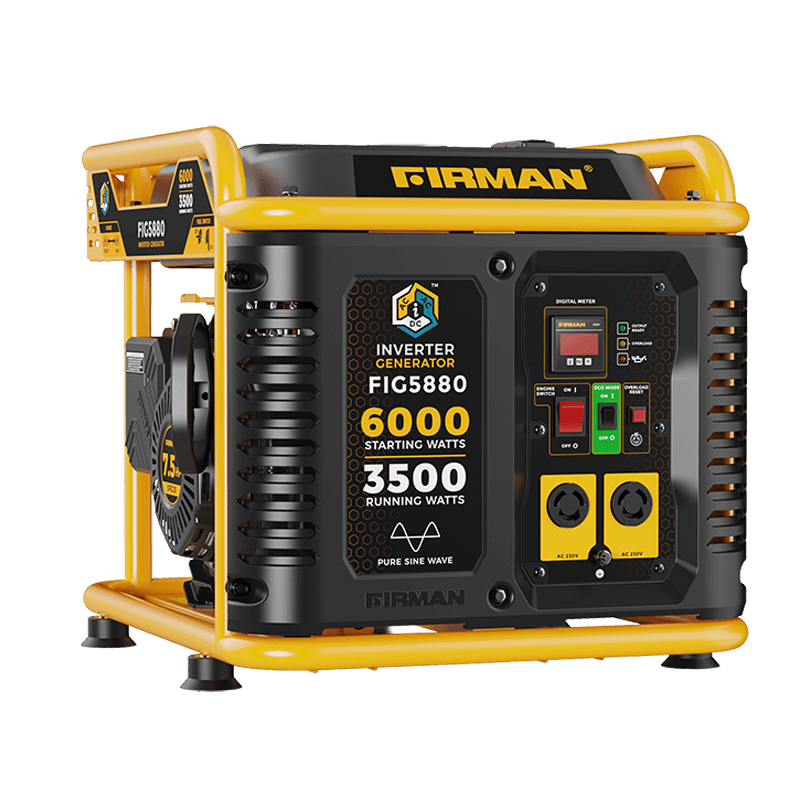
For homeowners who want the surge muscle of a workhorse petrol generator combined with the clean power and quiet fuel economy of an inverter, the FIRMAN FIG5880 (part of FIRMAN's OPEN Fi New Flagships Series) is engineered specifically to bridge that gap.
| Specification | Official Manufacturer Rating | Practical Meaning for Homeowners |
| Running Watts | 3,500W (Single Phase, Power Factor COSΦ = 1.0) | Comfortably runs a refrigerator, lighting, fans, electronics, and a room AC or sump pump simultaneously. |
| Starting Watts (AC Booster) | 6,000W | Provides over 50% extra surge capacity above running watts to start heavy inductive motor loads without tripping. |
| Power Quality (THD Purifier) | < 1.5% Total Harmonic Distortion | Pure sine wave electricity—safe for smart appliances, laptops, phones, and medical electronics. |
| Runtime (Marathon Runner) | Up to 18 hours @ 25% load / 11 hours @ 50% load | Runs through an entire night and into the next day on a single 12L tank without middle-of-the-night refueling. |
| Noise Level (Night Whisper) | 64 dB(A) @ 7 meters (at 25% load) | Quiet operation suitable for suburban yards and residential neighborhoods. |
| Engine & Starting System | SFE225 (223 cc displacement), Recoil Start | Tested through 1,000 hours of continuous factory durability operation. |
| Net Weight (Space Squeezer) | 29 kg (approx. 63.9 lbs) | Roughly 10% smaller and 30% lighter than conventional 3.5 kW generators—easy for one adult to position. |
Why FIG5880 Stands Out as an Electric Generator for Home
6,000W Surge Headroom in a 3,500W Footprint (AC BOOSTER):
FIG5880 can handle brief 6,000W starting surges, which facilitates the homeowners to kick-start demanding appliances.
Up to 17% Lower Fuel Burn (ECO FUELER):
Featuring smart ECO mode, the backup generator can automatically adjust the 223cc engine speed to match real-time appliance demand, reducing petrol consumption by up to 17% compared with standard generators and 8% to 20% compared with competing inverter generators in its class.
Microprocessor-Safe Clean Power (THD PURIFIER):
With Total Harmonic Distortion kept below 1.5%, you do not need a separate voltage stabilizer to protect laptop chargers, inverter refrigerators, or home office gear.
1,000-Hour Tested Durability in a 29 kg Frame (RUGGED SOLDIER & SPACE SQUEEZER):
Built with industrial-grade components validated across 1,000 hours of continuous testing, the open-frame inverter chassis weighs just 29 kg—eliminating the back-straining bulk of older cast-iron portable generators.
How to Choose the Best Portable Generator for Home Backup?
Step 1: What Consumers Demand Most in a Home Backup Generator
When comparing a portable generator for residential emergencies, first-time buyers often look only at maximum wattage. In real-world outages, five practical factors determine whether a generator is helpful or frustrating:
Starting Watts vs. Running Watts (The Compressor Surge Problem)
Appliances with electric motors, such as refrigerators, deep freezers, sump pumps, and window or split-system air conditioners, require 2 to 3 times their continuous running wattage for a few seconds at startup.
A generator rated for 3,000W running with only 3,300W starting may trip its breaker the moment an air conditioner compressor kicks on while the fridge is running.
Clean Power (THD) for Modern Household Electronics
Many modern refrigerators, washing machines, medical CPAP machines, laptops, and smart TVs rely on microprocessor control boards.
Conventional open-frame generators often produce Total Harmonic Distortion (THD) between 12% and 20%, which can cause LED lights to flicker, circuit boards to overheat, or backup UPS batteries to reject the charge. Look for an inverter generator rated below 3% THD (and ideally below 1.5% THD).
Overnight Fuel Efficiency (Avoiding 3:00 AM Refueling)
During a severe storm, nobody wants to go outside in the middle of the night with a petrol can to refuel a running generator.
A unit that automatically throttles down its engine speed when household demand drops at night (often called ECO Mode) stretches a single tank across an entire night's sleep.
Neighborhood-Friendly Noise Levels
Traditional 3.5 kW open-frame generators typically operate around 70–76 dB(A) at 7 meters. Looking for a model engineered around 64 dB(A) at 7 meters (comparable to normal background conversation at that distance) reduces household fatigue during long outages.
Single-Person Portability and Compact Storage
A home backup generator tends to sit in a garage or shed for most of the year and is rolled out when weather deteriorates, weight matters.
Traditional copper-wound 3.5 kW generators often weigh 42 to 50+ kg (92–110 lbs), requiring two adults to lift. Modern open-frame inverter designs cut that weight down toward 29 kg (64 lbs).
Step 2: Calculate Your Household Essential Load
Use the reference table below to estimate how a 3,500W running / 6,000W starting portable generator like the FIRMAN FIG5880 handles common residential combinations. (Note: Exact wattage varies by appliance model and energy efficiency rating; always check the nameplate sticker on your own equipment before connecting).
| Household Appliance | Typical Running Watts | Typical Starting (Surge) Watts | Can the FIRMAN FIG5880 (3500W Run / 6000W Start) Power It? |
| Modern Refrigerator / Freezer | 150W – 300W | 600W – 1,200W | Yes — Easily leaves >3,000W for other household circuits. |
| LED Lighting (8–10 Bulbs) + Wi-Fi Router | 80W – 120W | 80W – 120W (No surge) | Yes — Negligible load; safe for routers due to <1.5% THD. |
| Ceiling or Pedestal Fans (3 Units) | 150W – 225W | 300W – 450W | Yes — Ideal low-draw cooling for overnight ECO mode. |
| Laptops, Phones & 50-Inch LED TV | 150W – 300W | 150W – 300W | Yes — Pure sine wave protects sensitive chargers and screens. |
| 1.0 HP – 1.5 HP Room Air Conditioner | 800W – 1,400W | 2,200W – 3,500W | Yes — The 6,000W AC Booster surge handles AC compressor startup alongside a fridge and lights. |
| 0.5 HP Household Water / Sump Pump | 400W – 600W | 1,200W – 1,800W | Yes — Stagger startup so the pump and AC do not surge at the exact same millisecond. |
| Microwave Oven or Electric Kettle | 1,000W – 1,500W | 1,000W – 1,500W | Yes (Intermittently) — Pause high-draw cooling appliances briefly if you are already near the 3,500W running limit. |
Portable Generator Maintenance Schedule and Checklist
Here is the maintenance tips suggested by FIRMAN’s operational guidelines.
- Never Run Indoors: Never operate the FIG5880 inside a house, garage, basement, crawlspace, or porch, even with doors or windows open. Carbon monoxide is odorless and lethal.
- Protect Against Rain & Moisture: While portable generators operate across varied weather conditions, they must be sheltered from direct rain and standing water (using a dedicated open-sided generator tent or canopy well away from the house) to prevent short circuits and corrosion.
- Follow the Proper Startup & Shutdown Sequence: Always start the engine and let it stabilize before turning on the AC circuit breaker or plugging in appliances. Likewise, turn off and unplug all loads before shutting the engine down.
- Run Under Load Once a Month: Exercise your portable generator with a load once a month so fresh fuel circulates through the carburetor and internal components stay lubricated.
- Long-Term Storage Cylinder Protection: If you plan to store the generator unused for an extended off-season, drain old fuel and add a small amount of clean engine oil through the spark plug hole to coat the cylinder wall and prevent internal rusting.
Right-Sizing Your Home Backup for 2026
For households seeking a lightweight, fuel-efficient electric generator for home backup that won't damage sensitive electronics or require midnight refueling, the FIRMAN FIG5880 is worthy of consideration.
Ready to prepare your household before the next storm warning? View the full FIRMAN home backup solution or contact an authorized FIRMAN dealer to verify local availability and accessories for your home.
Frequently Asked Questions
Q1: Can I connect the FIRMAN FIG5880 directly to my home's electrical panel?
Yes, a portable generator can be used as a standby power supply during a utility outage, provided a licensed electrician installs an approved Manual Transfer Switch or interlock kit.
Never plug a generator directly into a household wall socket ("backfeeding"), as this sends lethal voltage back into utility lines and risks electrocuting utility lineworkers or causing a house fire. For simpler setups without a transfer switch, run heavy-duty, outdoor-rated extension cords directly to your appliances.
Q2: Why does Total Harmonic Distortion (THD) below 1.5% matter for home backup?
Many modern household appliances use sensitive microprocessor circuit boards. Standard portable generators often produce rough waveforms (12%–20% THD) that can cause electronics to malfunction or overheat. The FIG5880's <1.5% THD rating matches or exceeds the waveform cleanliness of standard utility grid power.
Q3: How much petrol should I keep on hand for a 24-hour power outage with the FIG5880?
With its 12-liter fuel tank, the FIG5880 runs for up to 18 hours at a 25% load (roughly 875W, enough for a refrigerator, LED lights, a fan, and phone/router charging) or 11 hours at a 50% load (1,750W).
Storing 20 to 25 liters of fresh, stabilizer-treated petrol in approved safety containers will typically support 24 to 36 hours of essential household operation depending on how frequently high-wattage appliances cycle on.
Q4: How can I verify that FIRMAN replacement parts or accessories are genuine?
To protect consumers from counterfeit spark plugs, filters, or components, FIRMAN operates an official Anti-Fake System. Always check that the anti-counterfeit security coating on the packaging is intact and verify the code online or through an authorized FIRMAN service center before installation.
References
- National Oceanic and Atmospheric Administration (NOAA), "El Niño Looms Large Over U.S. Winter Outlook (2026–2027 Temperature & Precipitation Forecast)," Official News Release, October 15, 2026, [https://www.noaa.gov/news-release/el-nino-looms-large-over-us-winter-outlook](https://www.noaa.gov/news-release/el-nino-looms-large-over-us-winter-outlook).
- World Meteorological Organization (WMO), "El Niño / La Niña Southern Oscillation (ENSO) Seasonal Updates & Classification Background," Official WMO Portal, 2026, [https://wmo.int/](https://wmo.int/).
- U.S. Consumer Product Safety Commission (CPSC) / Red Cross, "Portable Generator Carbon Monoxide (CO) & Electrical Backfeed Safety Guidelines," Official Safety Guidance, [https://www.cpsc.gov/Safety-Education/Safety-Education-Centers/Carbon-Monoxide-Information-Center/Generator-Safety-Information](https://www.cpsc.gov/Safety-Education/Safety-Education-Center
Share


Where to Find Our Social Media
for the Latest Updates?
Follow us on Facebook and Instagram to stay updating more information on our latest promotion activities and news #SUMECFIRMANNG #FORQUALITYLIVING


What can we
help you find today?