There is no single portable diesel generator that is the best for every buyer. The right choice depends on what you need to power, how often you move the machine, how long it must run, and how easily it can be serviced.
That question is especially relevant in African markets. Contractors, retailers, farms, workshops, and small businesses may rely on independent power for very different reasons. A generator that works well for a construction crew in Nigeria may not be the ideal choice for a shop in Ghana or a mobile worksite in South Africa.
For us, “best” means the closest match between the generator and the job.
“Best” Does Not Mean the Highest-Powered Generator
Buying the largest available machine may appear to be the safest option. In practice, excessive capacity can make a portable unit heavier and harder to move without solving a real power requirement.
The first question should therefore be simple: what equipment must operate at the same time? Add the running power of those loads, then identify equipment that draws significantly more power during startup.
Water pumps, compressors, and motor-driven tools deserve particular attention. Their starting demand can influence generator selection even when their normal running demand appears manageable.
A suitable unit should provide enough capacity for the actual workload. That is more useful than choosing a model simply because its maximum output looks impressive.
The Right Generator Depends on What You Need to Power
A small business may need electricity for lighting, refrigeration, computers, and basic equipment. A construction crew could instead require power for several tools and site equipment.
Those situations create different definitions of “best.” The generator for a retail outlet may prioritize straightforward operation and convenient placement. A contractor may place greater value on mobility and a rugged frame.
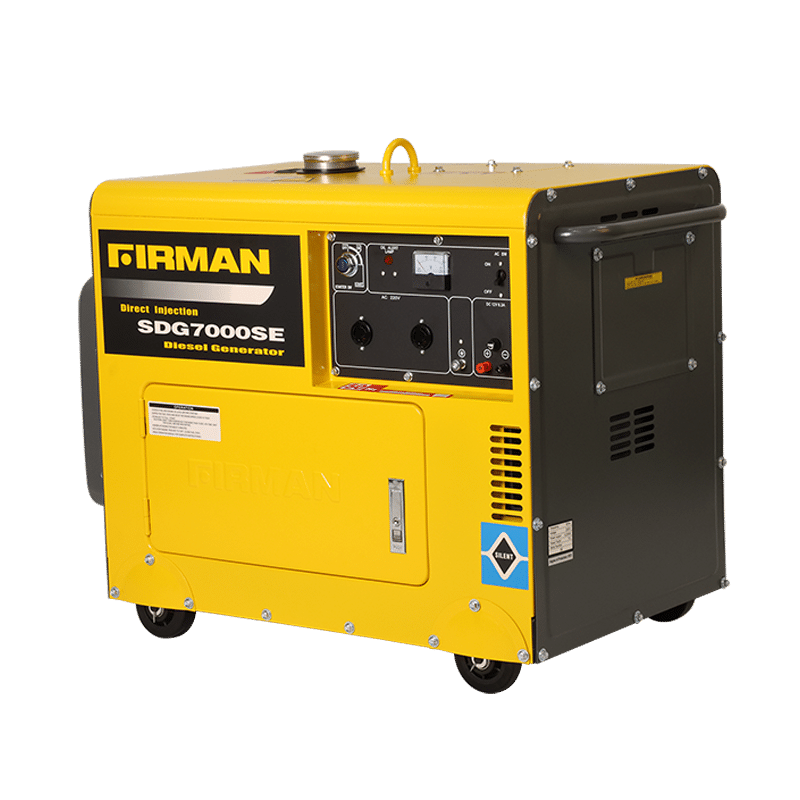
At FirmanFIRMAN, our portable diesel generator range illustrates the importance of checking individual specifications. FIRMAN's diesel generator models are available in different configurations and output capacities, so buyers should compare the rated output, starting capacity, fuel consumption, runtime, and other specifications according to their application.
The better choice between two similar units is therefore not automatically the more powerful one. It is the model that fits the customer's load without unnecessary capacity.our portable diesel range illustrates the importance of checking individual specifications. The SDG7500CLE is listed at 5.5 kVA starting power and 5.0 kVA running power, while the SDG8500CLE is listed at 6.5 kVA starting power and 6.0 kVA running power. Both specifications are given by the manufacturer.
The better choice between two similar units is therefore not automatically the more powerful one. It is the model that fits the customer's load without unnecessary capacity.
For African Sites, Mobility Can Matter as Much as Output
Portability becomes particularly important when electricity is needed away from a fixed building. Construction projects, agricultural operations, temporary work areas, and mobile service activities may require equipment to be repositioned.
Weight becomes part of the decision. So do wheels, frame design, starting method, lifting arrangements, and the distance over which the machine will be moved.
Portable diesel generators should be evaluated not only by their electrical output but also by their physical design. Features such as wheels, frame construction, starting method, lifting arrangements, and overall weight can affect how easily a unit can be moved between different work areas.
For African buyers, these physical characteristics should be considered alongside electrical output. A unit that meets the load but is impractical to transport may not be the best solution for a frequently changing worksite.The SDG7500CLE is listed with wheels and a 120 kg gross weight, while the SDG8500CLE has a listed gross weight of 125 kg. Both also offer electric and recoil starting.
For African buyers, these physical characteristics should be considered alongside electrical output. A unit that meets the load but is impractical to transport may not be the best solution for a frequently changing worksite.
Runtime Changes the Meaning of “Best”
Power output answers only part of the question. A buyer also needs to consider how the generator will be used throughout the working day.
Fuel-tank capacity provides one useful reference point when comparing portable diesel generators. Published runtime figures should also be considered alongside the load condition under which they were measured.
The load condition matters because actual fuel consumption changes with operating demand. Buyers should therefore avoid treating a published runtime as a fixed number for every working situation.Fuel-tank capacity provides one useful reference point. The SDG7500CLE is listed with a 12.5 L fuel tank, while its published specifications give approximately 6.5 hours of runtime at 50% load. The SDG8500CLE has the same stated 6.5-hour runtime at 50% load.
The load condition matters because actual fuel consumption changes with operating demand. Buyers should therefore avoid treating a published runtime as a fixed number for every working situation.
For a Ghanaian workshop or Nigerian business operating through long power interruptions, the practical question is not simply how much fuel the tank holds. It is whether the generator's expected operating pattern fits the working schedule.
A Good Generator Also Needs a Strong Supply Chain
The machine itself is only one part of the purchase. Once a generator enters daily commercial use, maintenance, replacement parts, and technical assistance can affect its long-term usefulness.
That consideration has particular weight for African buyers who may operate equipment far from major commercial centers. A low purchase price provides limited value if obtaining appropriate support later becomes difficult.
We therefore consider the supplier when evaluating power equipment manufacturers. Therefore, supplier capability is a critical factor when evaluating power equipment manufacturers.Service infrastructure, parts availability, technical assistance, and local distribution can all influence the practical value of a portable unit.
Our African operations include an overseas company and after-sales center in Nigeria, while wethe company also describes an African BAS channel system covering official service centers, brand stores, and after-sales shops.
That support structure is relevant to the “best” question because equipment performance depends partly on how effectively it can be maintained.
So, Which Portable Diesel Generator Is Best?
The best portable diesel generator is not necessarily the most powerful, largest, or cheapest model. It is the one that fits the intended load while remaining practical to move, operate, refuel, and maintain.
For a small African business, that could mean a compact diesel unit with enough capacity for essential equipment. For a contractor, portability and starting performance may carry more weight. For a farm or remote operation, runtime and service access may become decisive.
Instead of choosing a generator based solely on its product label or maximum output, buyers should begin with the application. Key factors include required output, starting surges, physical dimensions, fuel capacity, expected operating schedules, and available service support.Instead of starting with product labels, our methodology begins directly with the application. We then carefully evaluate and compare key factors, including required output, starting surges, physical dimensions, fuel capacity, operational schedules, and available support.
A portable diesel generator should ultimately be judged by how well it performs its intended role. As power equipment manufacturers, we see the buying decision as a matching exercise: the right output for the load, the right physical design for the location, and the right support for the market.
This brings much-needed clarity for African buyers. Rather than overcomplicating things, the right generator is the one that satisfies real-world power loads smoothly across transportation, day-to-day operation, and long-term service.
A portable diesel generator should ultimately be judged by how well it fits its intended role: the right output for the load, the right physical design for the location, and the right support for long-term use.
What can we
help you find today?