A tri fuel generator is specialized residential/ commercial power equipment engineered to run interchangeably on petrol, liquid petroleum gas (LPG), or natural gas. Small business owners across South Africa, Nigeria, and Tunisia constantly evaluate whether this flexible architecture justifies its initial capital expenditure.
Severe load shedding combined with sudden regional liquid fuel shortages leaves standard single-fuel backup systems without a fallback energy pathway, since their only fuel source is the one that has become unavailable. This does not make such systems useless in every scenario, but it removes their ability to operate when the disruption is both fuel-related and grid-related at the same time. Analyzing the true worth of this equipment requires calculating your exact financial tolerance for operational downtime.
In this guide, we compare fuel flexibility, operating requirements, power output, and ownership costs to help small businesses determine whether a multi-fuel generator is a practical investment.
Commercial enterprises cannot rely on generic consumer advice; they need industrial-grade resilience to survive harsh energy landscapes. Let us break down the tangible operational advantages of utilizing three distinct energy inputs.
Mechanics of Three-Way Fuel Architecture
Bypassing standard combustion limitations requires an advanced carburetor designed to regulate distinct gas pressures and liquid viscosities. Our engineers at Firman integrate a specialized selector dial that allows fast transitions between three distinct energy sources.
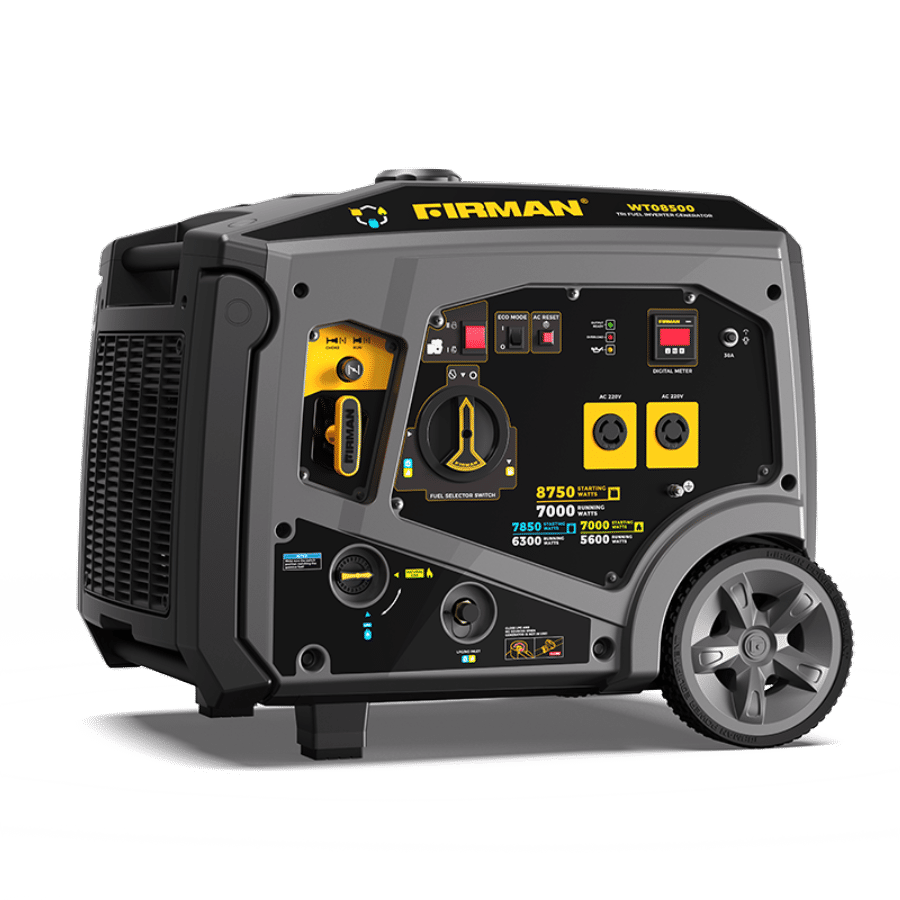
Specific models like the WT08500 perfectly demonstrate this capability, seamlessly pivoting from petrol to LPG without requiring mechanical retrofits. Operators simply close the primary liquid valve and open the connected gas line.
Different energy sources naturally yield varying peak wattage profiles across the exact same heavy-duty engine block. Petrol consistently provides the aggressive starting watts necessary to initialize heavy commercial compressors and large industrial fans.
LPG and natural gas can provide alternatives to petrol where the required supply and approved connections are available. Natural gas may reduce the need for manual fuel replenishment when a suitable pipeline connection is available, but operating duration still depends on fuel supply, maintenance requirements, load, and the generator's operating limits.
How Can a Tri-Fuel Generator Improve Fuel Flexibility?
Relying exclusively on imported liquid fuel leaves your daily operations highly exposed to port delays and regional distribution bottlenecks. Transitioning a portion of your backup power strategy to propane instantly builds a localized, decentralized energy reserve on your premises.
Propane does not degrade chemically over time, allowing businesses to safely stockpile emergency steel cylinders for multiple years. Building this independent reserve creates an impenetrable firewall against commercial disruptions.
Certain applications require both fuel flexibility and exceptionally clean, stable electrical output to protect sensitive equipment. Tri-fuel capability provides the flexibility to operate on petrol, liquid petroleum gas (LPG), or natural gas, while a portable generator with inverter technology delivers clean, stable power with low total harmonic distortion (THD).
Sensitive electronic equipment, such as medical diagnostic machines, point-of-sale terminals, and commercial server systems, can benefit from the stable sine wave output provided by inverter technology. Combining flexible fuel options with inverter technology offers greater fuel versatility and reliable power for applications requiring high-quality electrical output.
Supply chain agility is no longer a corporate luxury; it is a fundamental requirement for commercial survival across the continent. Panic buying at local petrol stations in Lagos or Accra simply prompts your business to pivot to its internal gas reserves.
Bypassing these localized monopolies guarantees that your commercial storefront remains fully illuminated and accessible to paying customers. Small enterprises mastering this logistical pivot consistently outperform competitors.
Operational Continuity for Clinics and Retail
Cold-chain logistics hubs and busy urban pharmacies face catastrophic inventory losses if commercial refrigerators lose continuous electrical power. A high-capacity tri fuel generator allows night-shift staff to immediately switch to a backup LPG tank if petrol runs dry.
When the fuel transition is performed according to the manufacturer’s procedure—stopping the engine, allowing it to cool, closing the valve on the fuel being left, and selecting the new fuel before restart—the generator can support continued operation of critical refrigeration loads.
Whether pharmaceutical supplies or perishable goods remain within their temperature limits also depends on the duration of the interruption, the thermal inertia of the refrigeration equipment, and whether loads are managed during the switch; the fuel change itself does not guarantee temperature control. Facility managers can confidently train floor staff to execute these routine fuel swaps safely.
Noise pollution remains another critical operational parameter for enterprises situated within dense urban centers or premium retail districts. Combusting LPG naturally softens the engine's acoustic footprint compared to the harsher explosions generated by traditional petrol ignition.
Maintaining a quieter operational environment actively prevents noise complaints from neighboring businesses while preserving a professional customer atmosphere. At Firman, we engineer our corporate fleet with specialized sound-dampened equipment to aggressively meet strict municipal decibel regulations.
Evaluating the Commercial Return on Investment
Justifying the initial capital expenditure requires shifting focus from the price tag to the drastically reduced total cost of ownership. LPG actively prevents the rapid accumulation of abrasive carbon deposits along the engine's internal pistons and delicate spark plugs.
Cleaner internal combustion significantly extends mandatory service intervals, sharply reducing the frequency of costly emergency mechanic visits. Over a typical three-year operational cycle, direct savings on maintenance heavily offset the initial premium.
Combining multi-source fuel capabilities with digital throttle control further maximizes your daily operational profit margins and fuel efficiency. A smart portable generator with inverter automatically down-tunes the engine speed when retail electrical demand decreases during off-peak hours.
Intelligent load-matching consumes a mere fraction of the fuel compared to traditional units locked at a continuous maximum rotation. Compounding these daily fuel savings ensures that adaptable power architecture acts as a strategic asset.
Deciding to purchase versatile multi-fuel equipment ultimately depends on how much capital your business bleeds during a blackout. The definitive return on investment materializes the exact moment a localized petrol strike fails to halt your daily revenue generation.
Utilizing LPG for continuous daily operations while reserving liquid fuel strictly for emergencies drastically lowers internal engine wear. Upgrading to a high-performance electrical output removes supply chain anxiety entirely.
Our flagship Firman units like the WT08500 prove that versatile power architecture fundamentally secures your long-term commercial trajectory. Relying on our engineered systems ensures your enterprise successfully decouples its daily productivity from unpredictable regional fuel markets. Securing localized energy independence provides the ultimate competitive advantage for modern facilities operating in challenging grid conditions.
What can we
help you find today?