Frequent power cuts across Lagos, Accra, and Johannesburg force property owners to rethink emergency power. Many buyers assume purchasing the best home standby generator represents the definitive answer to grid failure. Stationary home standby generator promise seamless automatic changeover whenever public utility substations collapse.
Yet real-world conditions often turn these massive assets into expensive operational burdens. Evaluating worth requires looking beyond marketing promises and examining local fuel supply, electrical architecture, and real daily runtime demands.
African energy markets operate under structural and chronic strain, in contrast to Western grids where outages, though also driven by extreme weather, aging infrastructure, and operational failures, tend to be episodic rather than routine. South African consumers routinely navigate scheduled Stage 4 or Stage 6 load shedding. Nigerian entrepreneurs and families endure multi-day national grid collapses alongside unpredictable voltage surges. Running a dedicated 20–30 kVA stationary plant (roughly 16–24 kW of active power at a typical 0.8 power factor) every afternoon burns excessive fuel...
African Grid Realities Redefining Backup Economics
Stationary units require substantial capital upfront. A fixed standby system may require more than the generator itself. Depending on the installation, costs can include a suitable foundation, electrical transfer equipment, wiring, fuel-system work, permits, and professional installation. Buyers should request a complete installed-cost quotation rather than compare equipment prices alone. Local import tariffs and freight surcharges quickly push total project expenditure far past initial equipment quotes.
High capital expenditure creates long payback periods for commercial premises and residences alike. Property owners frequently spend huge capital reserves before the unit produces its first kilowatt-hour.
Deploying a modern portable generator with inverter technology avoids site reconstruction entirely. Clean electrical output protects sensitive desktop hardware, communication switches, and medical refrigeration without demanding civil engineering modifications.
Operating expenses create the next economic challenge. Massive diesel plants consume significant liters per hour even under light electrical draws. Given fuel subsidy removals across West Africa and steep diesel tariffs in Southern Africa, running excessive engine capacity destroys household budgets. Stationary units throttle engine revolutions downward during low demand periods, wasting costly fuel on trivial loads.
True Ownership Costs of Stationary Standby Systems
Mechanical wear accelerates rapidly when standby equipment runs hundreds of hours each month instead of standing on idle standby. Regular filter replacements, lubricant flushes, and injector servicing demand qualified local technicians who may not always be readily available. Sourcing proprietary replacement components across sub-Saharan supply chains introduces prolonged downtime during critical blackout seasons.
At Firman, we monitor how localized electrical infrastructure affects mechanical longevity. Fixed standby engines suffer severe stress when unstable utility voltage alternates erratically with generator power before fully stabilizing. Automatic transfer switches often chatter violently during partial brownouts, leading to premature switchgear failure.
Operational Friction: Fuel Supply and Grid Characteristics
Fuel availability dictates survival during prolonged regional blackouts. Most permanent home units rely strictly on single fuels, generally diesel or fixed piped gas. Piped natural gas remains virtually non-existent for suburban neighborhoods across African cities, while bulk diesel storage invites degradation, contamination, and security risks.
Flexibility determines true value during emergency shortages. Our engineering team addressed this vulnerability by developing multi-fuel systems. Operating a versatile portable generator with inverter capability enables users to pivot instantly between standard gasoline, LPG cylinders, and natural gas. Bottled gas stores safely for years without deteriorating or gumming up delicate carburetors during quiet months.
Noise pollution creates another hidden cost in tight urban residential estates. Heavy industrial standby generators produce intense acoustic resonance that irritates neighbors and violates municipal noise regulations. Compared with conventional stationary generators without acoustic enclosures, portable generators with sound-attenuating canopies can offer quieter operation in residential settings.
Sizing Smartly: Critical Circuits Versus Total House Loads
Smart power planning focuses on running necessary equipment rather than energizing every lighting loop and water heater. Commercial offices must keep workstations, optical communication routers, server racks, and security gates active. Modern families need water pumping, cold storage, security illumination, and air conditioning in core living areas.
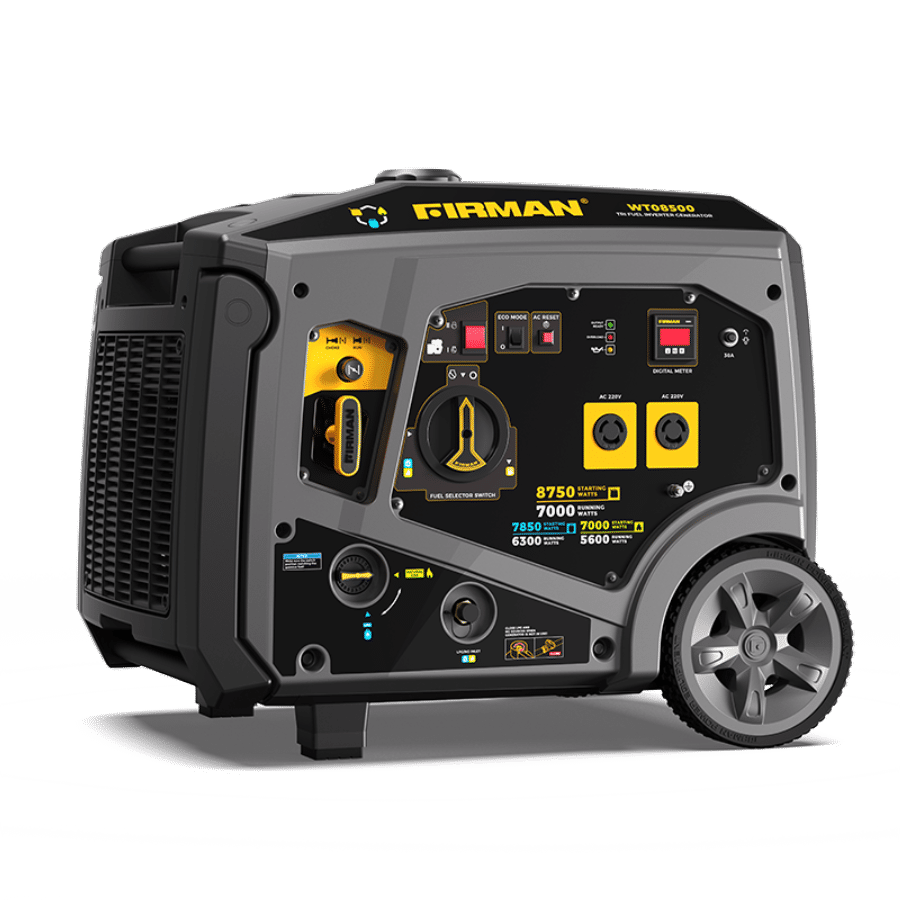
Calculating true continuous running requirements for essential circuits — refrigeration, water pumping, basic lighting, and communications — typically yields a far lower load than the total connected household demand. We designed the Firman WT08500 tri-fuel inverter generator precisely around this operational sweet spot. Delivering 5.50 kW running output on gasoline and 5.00 kW on LPG, it easily supports heavy starting surges up to 6.85 kW without overloading.
Selecting a portable generator with inverter architecture ensures total harmonic distortion remains low enough for delicate diagnostic equipment and optical gear. Heavy stationary generators with rudimentary voltage regulators can produce harmonic distortion, potentially damaging sensitive electronics. Inverter-based generator architecture can help reduce harmonic distortion delivered to connected loads, which is relevant for electronics and motor-driven appliances that are sensitive to poor power quality. However, no generator can guarantee compatibility with every specific device; users should verify the input tolerances of critical equipment.
Balancing Capital Cost and Daily Reliability
Deciding whether a stationary whole-home standby generator is worth the expense hinges on your exact operational profile. Large estates with commercial poultry operations or critical manufacturing facilities are particularly well suited for investing in a stationary home standby generator. For these users, choosing the best home standby generator can be a worthwhile investment, as the high financial stakes of uninterrupted power supply can offset substantial installation costs and ongoing fuel expenses.
Small-to-medium businesses, branch offices, and private homeowners find far greater economic return through mobile, high-efficiency equipment. Investing a fraction of the cost into an adaptable unit like the WT08500 can preserve vital operational capital while supporting immediate power continuity for essential loads — provided fuel and maintenance are adequately planned for.
Reliable electric starting, multi-fuel flexibility, and the ability to be easily moved over short distances make portable generators a versatile power solution for various applications. Matching power equipment directly to essential loads prevents overcapitalization, reduces fuel consumption, and delivers cost-effective backup power with greater operational flexibility.
What can we
help you find today?