A 3500 watt generator can provide useful home backup power when the goal is to keep essential appliances running rather than power the entire house. For households in Ghana, Nigeria, South Africa, and other African markets, it may cover refrigerators, lights, fans, Wi-Fi equipment, and other smaller loads.
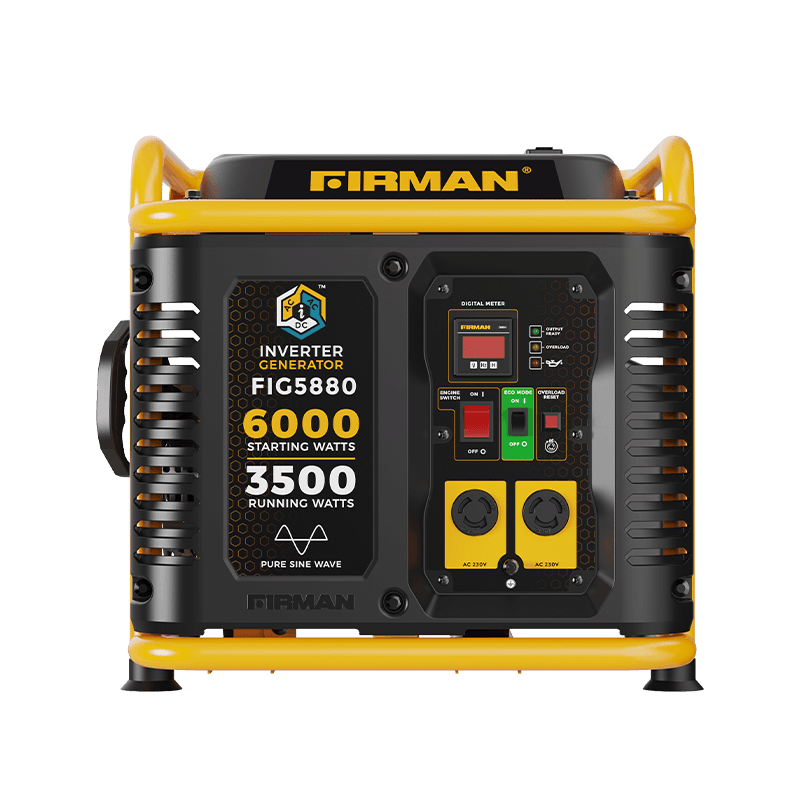
The main limitation is starting power. Refrigerators, water pumps, and other motor-driven appliances can draw more power when they start, so buyers should check both running and starting watts before deciding whether 3,500 running watts and 6,000 starting watts is enough.
In practical terms, 3,500 watts is generally better suited to essential backup than whole-home operation. A household may be able to run a refrigerator, several LED lights, fans, internet devices, and small charging devices together, depending on their actual power ratings. Larger loads should be added selectively rather than assumed to run continuously alongside everything else.
Residential users often consider fuel economy and noise levels alongside power output during emergencies. Noise can also matter in densely populated residential areas. A quieter generator is easier to live with during evening outages, particularly when the unit may need to operate for several hours.
Generator noise levels can affect residential comfort during prolonged outages, so buyers should consider models with suitable noise-control features. Balancing sound levels with raw engine strength protects community harmony during emergencies.
Handling Starting Surges and Heavy Appliances
A 3,500-watt generator may support essential household loads such as a refrigerator, LED lights, fans, a Wi-Fi router, a TV, and small charging devices, depending on their actual running and starting requirements. Higher-demand appliances like air conditioners, water pumps, kettles, microwaves, and water heaters require close load calculations. Their combined running or starting demand can easily exceed a petrol generator's capacity.
Add the running wattage of the appliances you expect to use at the same time, and then check the starting demand of the largest motor-driven appliance. If the total is too close to the generator's rated output, reduce the number of simultaneous loads.
Once your power needs are sorted out, safety and placement become the next critical priorities. Hot weather makes ventilation particularly important during long outages. Generators should be operated outdoors with sufficient clearance around the unit, and exhaust gases must be directed away from occupied areas. Keeping air passages clean also supports reliable operation.
Fuel Efficiency and Daily Maintenance Realities
Fuel efficiency also affects the practical cost of running a petrol generator during a long outage. Buyers should compare fuel consumption, tank capacity, and expected runtime rather than looking only at wattage. Lower fuel consumption can help reduce refueling frequency and operating costs when backup power is needed for several hours.
Fuel availability also matters during extended outages. Buyers should consider tank capacity, expected runtime, and access to petrol near the home. A longer runtime can reduce the need for refueling, particularly when traveling to a filling station is inconvenient.
Runtime should also be considered against the expected outage period. For overnight backup, a generator that runs for several hours at a moderate load is often more practical than a smaller unit that needs frequent refueling. Buyers should compare runtime at the stated load rather than relying only on tank capacity.
Routine maintenance is essential for reliable backup power, particularly in dusty or humid environments. Engine oil, air filters, spark plugs, and other service items should be checked and replaced according to the manufacturer's maintenance schedule. Keeping the air filter clean also helps prevent abrasive particles from entering the engine.
Safety should be part of generator sizing and installation. Operate the unit outdoors, use correctly rated cables, and follow the manufacturer's grounding and connection requirements. If a transfer switch is used for household circuits, have it installed by a qualified electrician to prevent dangerous backfeeding.
Is 3,500 Watts Enough for Your Home?
For many homes, a 3,500-watt generator can provide useful backup for essential loads such as a refrigerator, lights, fans, Wi-Fi router, TV, and small charging devices. However, running several high-demand appliances together can quickly exceed its available capacity.
If your home also needs an air conditioner, water pump, electric water heater, or other motor-driven equipment, check both running and starting watts before making a decision. The safest approach is to prioritize essential appliances and leave enough capacity for startup surges.
At FIRMAN, we provide generator options for different household power requirements. The right choice is not necessarily the highest-output model, but one that can reliably handle the appliances you need during an outage while remaining practical for your fuel, space, and operating needs.
A 3,500-watt generator can be enough for home backup when the priority is essential appliances rather than whole-house power. Before buying, calculate both running and starting watts for the appliances you expect to use, and then consider fuel availability, runtime, noise, ventilation, and maintenance. For homeowners in Ghana, Nigeria, South Africa, and other African markets, choosing the right generator size can provide dependable backup without paying for capacity that is rarely needed.
What can we
help you find today?