Are site operations truly aligned with your power equipment? For contractors comparing portable generators for construction, the right choice demands a careful balance of electrical capacity, mobility, fuel logistics, and site demands.
A contractor building homes outside Accra may need to move power between structures, while a road crew working away from the grid may depend on a generator throughout the working day.
A small commercial project in South Africa can have yet another load pattern, with tools, lighting, and battery chargers competing for temporary power.
We recommend making the selection from the job backward. Identify the equipment that needs electricity, calculate its real operating and starting demand, then consider mobility, fuel supply, and outdoor conditions. This approach helps contractors avoid paying for unnecessary capacity while reducing the risk of choosing a generator that cannot support the work.
Which Construction Tasks Will the Generator Actually Need to Support?
Contractors should start with the work schedule rather than a generator catalogue by writing down the electrical tools that the crew expects to use during the busiest period of the day.
A residential construction crew may operate drills, angle grinders, saws, lighting, and battery chargers. A contractor working on drainage or water infrastructure may add a pump. Road and other civil works can introduce different equipment again, particularly where temporary power is required far from permanent electrical connections.
The important number is the combined load that may run simultaneously. A site rarely runs every electrical device at once, so simply adding up all the nameplate ratings will result in an oversized and unnecessarily expensive generator.
African construction sites also change as projects progress. Early groundwork may have a different electrical profile from later installation or finishing work. Selecting equipment around the busiest realistic combination gives the contractor a more useful capacity target.
For a small site, a petrol generator can be particularly practical when the crew needs temporary electricity in several locations rather than a permanent power installation. Petrol-powered equipment can also be useful where grid access is limited or temporary connections are not practical. The objective is not maximum output, but sufficient capacity for the work actually being performed.
What Happens When the Biggest Tool Starts?
Running wattage alone cannot determine whether a generator is suitable. Certain motors require a temporary surge when they start, so the generator must handle that event while supporting equipment that is already operating.
Imagine a crew charging tool batteries and running site lighting when a water pump starts. The pump may require considerably more power for that brief moment than its normal operating rating suggests.
A generator with insufficient starting capacity may struggle even when its rated running output appears adequate. For this reason, contractors should compare both rated and maximum output when evaluating a petrol generator for construction, rather than relying on running watts alone.
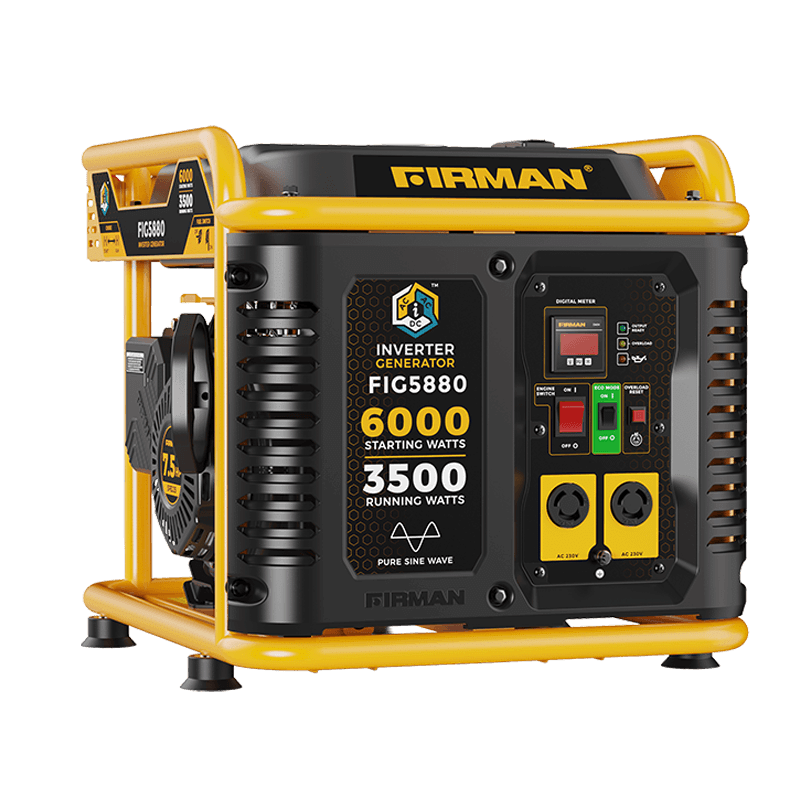
Powered by a 223cc SFE225 engine, the FIG5880 has a rated output of 3,500W and a maximum output of 6,000W. Before selecting this model, contractors should always cross-reference these power specs with the actual starting and running requirements of their equipment.
Can the Generator Follow the Work as the Site Moves?
Construction power rarely stays in one place. A small building project may shift electrical work from one structure to another. Remote road or infrastructure projects can involve even greater movement as crews progress along the site.
That makes physical handling part of generator selection. Portable generators for construction should be assessed by weight, dimensions, starting method, and available transport arrangements alongside their electrical specifications. A generator that is technically powerful enough but difficult to move can still reduce productivity on a changing site.
The generator also needs to fit the crew's actual working routine. A unit that requires special lifting equipment every time it moves may create unnecessary delays on a project where workers regularly change locations.
The FIG5880 weighs 29kg and uses recoil starting. That physical specification can be relevant for smaller projects where portability is a regular part of the workflow.
Safe positioning is equally important when moving or relocating the generator. Operators should keep the unit outdoors with adequate ventilation and prevent exhaust gases from entering enclosed or occupied areas. Cables should also be arranged to avoid creating additional hazards around active work zones.
Will One Fuel Load Cover the Planned Work Period?
Fuel planning becomes more significant when construction takes place away from major urban centres. A contractor might need to transport fuel to a rural building project, or coordinate supplies for a road crew working hours away from the nearest fuel station.
The question is therefore not simply whether a generator has a large tank. Contractors should compare tank capacity, expected fuel consumption, and daily operating hours when evaluating portable generators for construction, particularly for projects far from convenient refuelling points.
The FIG5880 has a 12L fuel tank. Its published specifications indicate up to 18 hours of runtime at 25% load and up to 11 hours at 50% load. Actual runtime varies according to load and operating conditions.
A crew using mostly lighting and battery chargers may operate at a much lower average load than one running power tools continuously. Estimating the expected load gives a more realistic picture of daily fuel requirements.
For African contractors, this calculation can also support logistics planning. Fuel storage, transport, site security, refuelling time, and availability should be considered before the generator becomes a critical part of the project's daily workflow.
What Changes When the Generator Works Outdoors?
Construction generators often operate in open areas rather than controlled plant rooms. Dust from unpaved access roads, concrete work, excavation, and material handling can become part of the operating environment.
Heat and rain create additional challenges. The generator needs adequate airflow, while its placement should provide reasonable protection from water and physical impact without restricting ventilation.
These conditions matter across many African construction projects, especially where temporary power is being used on exposed sites. Regular inspection and maintenance should reflect the actual environment rather than assuming clean, sheltered operation.
Noise may also affect placement. A generator working beside homes, offices, schools, or occupied commercial premises needs a location that limits unnecessary disturbance. The FIG5880 is specified at 64dB(A) at 7m under a 25% load condition.
How Can a Contractor Validate the Choice Before Purchase?
A practical final check can prevent most selection mistakes. Consider a contractor constructing several residential units where grid electricity is unavailable at the active work area. The crew needs lighting, chargers, drills, grinders, and a pump used intermittently.
First, identify which equipment will operate together. Second, find the largest starting demand and compare it with the generator's maximum output. Third, compare the combined running load with the rated output.
Next, test the physical and logistical assumptions. Can workers move the generator safely? Can fuel reach the site without disrupting the workday? Is there a suitable outdoor location with sufficient ventilation and protection?
A model such as the FIG5880 can be evaluated when its 3,500W rated and 6,000W maximum outputs fit the calculated site demand. Larger construction operations should be assessed against higher-capacity equipment rather than assuming that one portable model can serve every project.
Selecting a generator means matching the machine to the site's actual workflow. We at FIRMAN recommend checking electrical demand, startup requirements, movement, runtime, fuel logistics, and operating conditions together before purchase.
The strongest choice is not necessarily the generator with the biggest output. It is the machine whose capacity and physical design fit the work being performed. For construction contractors across Africa, a careful site-based assessment can turn generator selection from a simple wattage comparison into a practical equipment decision.
What can we
help you find today?