Large construction projects in South Africa, Ghana, and other African markets can quickly outgrow a generator that looked suitable during the planning stage. Electrical demand may increase as new work areas open, while pumps, welding equipment, temporary offices, lighting, and other site systems compete for available power. Selecting industrial generators therefore requires contractors to evaluate the entire construction schedule rather than focusing on one specification.
For projects operating in areas with limited or unreliable grid access, the generator may become a central part of the temporary power system. The selection process should answer a practical question: can the machine provide the required power, in the required environment, for the required stage of construction?
What Size of Industrial Generator Does a Large Construction Project Actually Need?
Generator capacity should begin with the project's electrical workload, not with the physical size of the construction site. A large building does not automatically require the same generator capacity as a large road, mining, infrastructure, or industrial project.
Contractors should establish which loads will operate simultaneously and which ones represent the highest demand. A generator supplying several essential construction systems may need considerably more capacity than one serving only lighting and a temporary office.
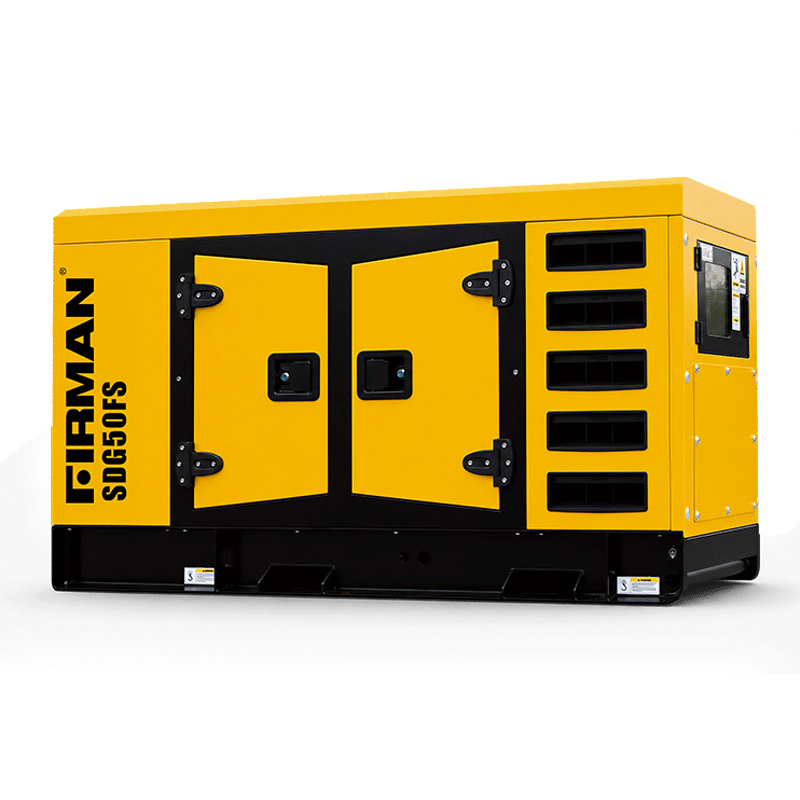
Prime and standby ratings should also be separated during this assessment. The SDG50FS, for example, is listed at 40kW/50kVA prime power and 44kW/55kVA standby power.
Which Construction Loads Should Determine Generator Capacity?
Construction equipment should provide the foundation for the capacity calculation. Pumps, compressors, welding equipment, power tools, lighting systems, temporary offices, and other electrical loads can create very different demand profiles.
Motor-driven equipment deserves particular attention because starting demand can be higher than normal running demand. A generator that appears adequate when every device is assessed only by its running consumption may struggle when several motors start together.
Voltage and phase configuration also need to match the site's electrical distribution. The SDG50FS is specified as a three-phase generator with 230/400V rated voltage and 50Hz frequency.
That makes the generator's electrical configuration part of the selection decision, not merely a technical detail to check after purchase.
Will the Generator Still Fit When the Project Enters Its Next Phase?
Construction power requirements rarely remain unchanged. On a large housing or infrastructure project, early groundwork may involve pumps and basic site facilities, while later stages can introduce additional tools, temporary buildings, lighting, and finishing equipment.
A generator selected only for the first phase can therefore become restrictive later. Contractors should map expected electrical loads across major project stages and determine whether the same generator will remain suitable.
This does not necessarily mean selecting the largest machine available. Excess capacity can also be inefficient if the generator normally operates far below its intended working range. The better approach is to understand the project's expected load progression and select equipment around the actual operating plan.
Can It Handle Dust, Heat, and Exposed Site Conditions?
Electrical suitability is only half of the selection decision. On construction sites in dusty peri-urban areas or hot regional climates, dust buildup and high ambient temperatures can affect engine cooling, air filtration, and service intervals. Contractors should therefore consider enclosure design, ventilation, filtration, and protection against moisture when comparing industrial generators.
The SDG50FS uses a soundproof enclosure with heavy-duty rockwool insulation. Its product information also specifies waterproof, flame-resistant, and heat-resistant construction, with an IP23 protection class.
A suitable industrial generator must therefore be considered together with its installation area, access requirements, and site protection measures.
How Long Must the Generator Support a Working Day?
Runtime becomes a project-management issue when the generator is expected to support extended construction activities. Frequent refueling can interrupt work, while remote projects may face additional challenges getting fuel to the operating location.
The SDG50FS has a listed 105-liter fuel tank and a stated runtime of at least eight hours. Actual runtime depends on load and operating conditions, so contractors should use the published figure as a reference rather than assuming identical performance at every load level.
What Should Contractors Check Before Approving the Final Generator?
Before approving industrial generators for a major project, contractors should bring the electrical and operational requirements together. The generator's prime rating should correspond to the planned duty, while voltage, frequency, phase, and starting requirements should match the site's equipment.
Physical handling also deserves attention. The FIRMAN SDG50FS includes lifting hooks and forklift access, while its listed net weight is 1,000kg. Those specifications should be considered when planning delivery, positioning, relocation, and maintenance access.
Monitoring is another practical checkpoint. The SDG50FS has a control panel with built-in real-time monitoring, with an optional digital controller available with configurable modes.
A generator with the highest rating isn't always the ideal choice for big building projects. The ideal choice means that its control system, physical design, electrical capacity, duty rating, handling provisions, and fuel arrangement all line up with the job's real workflow.
A suitable construction generator should support today's workload while remaining appropriate for the planned project stages. Reviewing the equipment loads, starting demands, operating duration, site conditions, movement requirements, and fuel logistics together gives contractors a much stronger basis for selecting industrial generators.
The SDG50FS illustrates this project-focused approach with 40kW/50kVA prime power and 44kW/55kVA standby power, three-phase 230/400V output, a 105-liter fuel tank, enclosed soundproof construction, lifting and forklift provisions, and integrated monitoring.
The ideal generator for a contractor's needs will be the one that takes into account the site's real demands, conditions, runtime, and logistics. That approach helps large projects maintain dependable temporary power without paying for capacity or features that the site does not need.
What can we
help you find today?