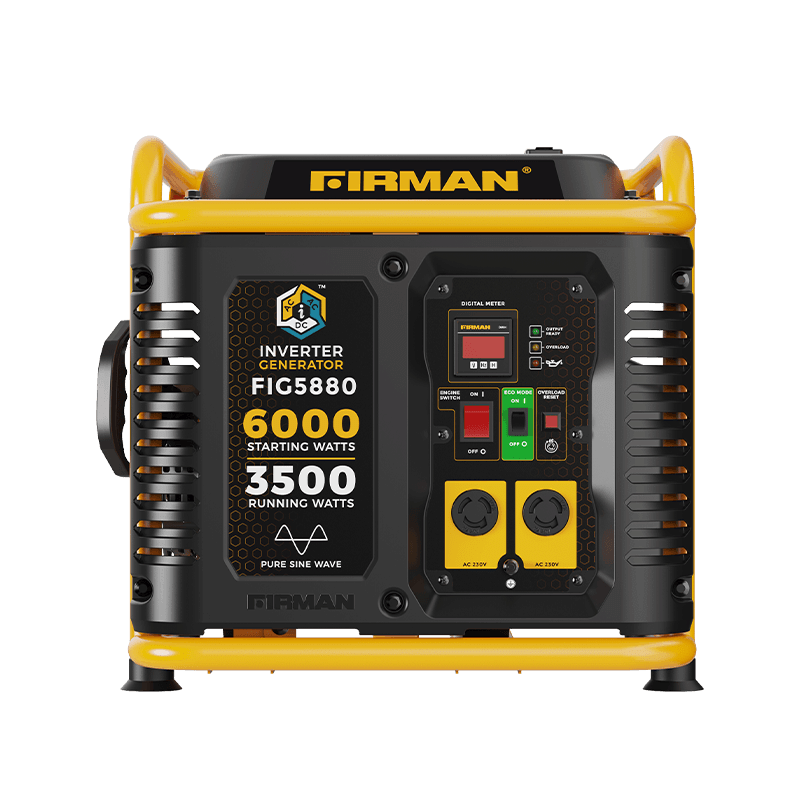
A low noise electric generator for a home or small business has to do more than produce enough electricity. It must fit the load, remain unobtrusive around people, and stay practical to move, refuel, and store. For households facing unreliable grid supply or small businesses that cannot afford interruptions, choosing a low noise electric generator should begin with operating conditions rather than headline wattage. The FIG5880 is a petrol-powered option designed for home backup and outdoor use.
We start by asking what must stay on during an outage. A home may prioritize a refrigerator, lights, router, television, fans, or a small pump. A salon may need lighting, fans, payment equipment, and selected appliances, while a small office may place greater importance on computers, routers, and stable power for sensitive electronics.
Size the Generator Around Real Loads, Not the Biggest Appliance
The first calculation separates running watts from starting watts. Motors in refrigerators, pumps, compressors, and air conditioners can demand a temporary surge when they start. A suitable low noise electric generator therefore needs enough starting capacity for the largest likely combination of loads, while its continuous rating should cover normal operating demand.
The FIG5880 shows why both figures matter. It is rated at 3,500W running power and 6,000W starting power, giving a household or small business room for short startup demands without selecting a much larger machine. Its single-phase output also fits many conventional small-load applications.
African users should map loads around actual routines. A household in Johannesburg may want refrigeration, lighting, internet devices, and selected kitchen appliances during an outage. A small shop in Accra might prioritize a refrigerator, lights, fans, and payment equipment. Those lists can produce very different sizing decisions.
Treat Noise as an Operating Requirement
Noise should be evaluated at a stated distance, not through vague labels such as "quiet". Placement, surrounding walls, load, and the generator's operating condition can affect what people experience. Buyers should compare published sound measurements under comparable conditions.
For the FIG5880, the published noise level is 64dB(A) at 7m and 25% load. Sound ratings should only be compared when measurement distance and load conditions are similar, since both factors can affect the reported noise level. Its ECO FUELER feature menas this generator can automatically adjust engine speed to optimize fuel use, while the manufacturer positions the model for residential and outdoor use.
That makes a low-noise generator more relevant for homes, guest facilities, small offices, and shops where people remain close to the equipment. Still, quiet operation does not make indoor use acceptable. The product guidance states that generators should never be operated indoors and should be protected from short circuits and rust when used in changing weather.
In areas where outages can last several hours, such as residential neighborhoods or small commercial districts, noise and refueling convenience become daily operating considerations rather than optional features. A generator placed near a home, storefront, or customer-facing workspace should be selected with its surroundings in mind.
Match Fuel, Runtime, and Movement to Daily Use
Equipped with a 12L fuel tank, the FIG5880 petrol generator is specified for up to 18 hours at 25% load or 11 hours at 50% load, making it suitable for home backup and other intermittent power applications. Even with this strong efficiency, buyers should carefully weigh practical factors before purchase, including fuel storage, refueling frequency, and safe outdoor placement.
Portability can be equally important. At 29kg, the FIG5880 is designed to be easier to move and store than a substantially larger set. That matters for homes where the generator must be brought out only during an outage, or for small businesses that need flexible positioning between operating areas.
Check Power Quality Before Connecting Sensitive Equipment
A generator is not selected only by its wattage. Computers, routers, televisions, charging systems, and other sensitive electronics can be affected by unstable or distorted power. Buyers should therefore check published power-quality specifications when these devices are part of the essential load.
The FIG5880 specifies THD below 1.5%, making power quality a useful selection criterion for a small office, home workstation, or retail counter rather than an afterthought.
Choose the Generator That Fits Your Actual Outage Needs
Before purchasing a petrol generator, we advise considering three factors: how near people will be to the machine, what equipment must run at the same time, and what beginning surge is possible. After that, include things like fuel availability, anticipated runtime, mobility, and power-quality needs.
Large generators aren't always the greatest option for homes or small businesses. The right choice is a machine whose noise level, fuel consumption, physical size, and operating characteristics fit the location and whose starting and running capacities match the required load. With an appropriately large set, backup may be provided with minimal logistical hassle.
At FIRMAN, we know buyers need concrete specifications. For buyers considering the FIG5880, its 3,500W running output, 6,000W starting output, 64dB(A) noise level at 7m, and 29kg net weight provide concrete reference points for the selection process.
FIRMAN keeps the selection principle straightforward: check running and starting power, measured noise levels, runtime, portability, and power quality before purchase. Reliable backup without extra capacity, fuel expenses, or running noise is possible when you shop for a generator with these needs in mind. Essential operations should be supported by a well-matched petrol generator without adding unnecessary capacity or operating costs.
What can we
help you find today?