A large construction project can outgrow a generator surprisingly quickly. One part of the site may be running pumps while another uses saws, compressors, welders, lighting, and temporary offices. Choosing equipment from the largest machine on the site is therefore unreliable.
We need to size the generator based on the most demanding realistic load combinations, work cycles, and environmental factors. For African construction projects in particular, this is crucial given the hot, dusty, remote, and volatile conditions they often operate in.
Build the Generator Specification From the Work Schedule
The construction schedule should be the starting point for generator selection.
List every electrical machine that may operate during each major work phase. Include grinders, saws, compressors, pumps, welders, lighting, site offices, security equipment, and other temporary facilities. Then identify which items can run simultaneously.
In our sizing guidance, we recommend adding together the running power of appliances that may operate simultaneously, and then including the highest additional starting requirement from any motor-drivenmotor- or compressor-driven equipment. We also advise building in a reasonable safety reserve.
This approach is more useful than simply asking for a “"large”" generator. A road project in Nigeria, a commercial development in Ghana, and a mining-related construction project in South Africa can have completely different electrical profiles.
The work sequence also matters. If several high-demand machines are normally used at different stages, the generator may not need to cover their theoretical combined maximum. If they regularly overlap, that combined demand becomes much more important.
Find the Site's Hardest Electrical Moment
The most important sizing question is not “How much power does the site use?” It is “What is the highest realistic demand when equipment starts or runs together?”
Motor-driven construction equipment can create a significant temporary demand. FIRMANFIRMAN notes that air compressors, tile saws, table saws, and industrial vacuums can draw substantially more power during startup than during normal operation.
That distinction can change the generator specification. A machine may appear suitable based on running watts but struggle when a compressor or pump starts.
Project teams should therefore identify the equipment with the largest starting requirement and determine whether multiple motors could start at the same time. A generator that repeatedly approaches its limit may create unstable operation rather than dependable site power.
When dealing with larger installations, we know that power factor also demands close attention. As we at FIRMAN often explain, kilowatts represent real power while kilovolt-amperes represent apparent power, with kW calculated simply as kVA multiplied by the power factor.
For procurement, the practical lesson is simple: provide suppliers with the actual equipment list and starting requirements before comparing quotations.
Match the Generator to How the Project Will Actually Use It
Construction generators can serve different roles. Some sites need power throughout the working day because grid electricity is unavailable. Others use a generator primarily as backup when utility power fails.
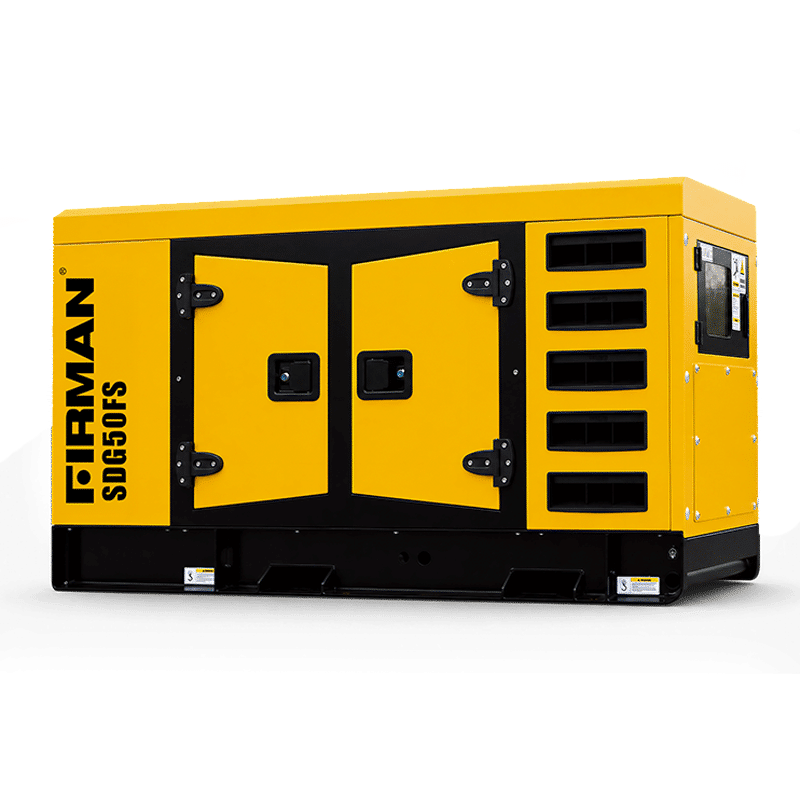
That difference affects how we evaluate the rating. The referenced SDG50FS, for example, is specified at 40 kW/50 kVA prime power and 44 kW/55 kVA standby power.
A project that relies on generated electricity during regular operations should pay particular attention to the prime rating and expected duty pattern. Standby capacity should not simply be treated as the normal operating target.
Fuel selection follows the same logic. We at FIRMAN state that diesel generators are commonly selected for frequent operation and commercial applications.Diesel generators are commonly selected for frequent operation and commercial applications.
For a major African job site, the decision should therefore reflect actual working hours, expected load, utility reliability, and the project's remaining duration.
Reject a Generator That Cannot Survive the Site's Reality
Check Whether the Generator Fits the Site Environment
Electrical capacity is only one part of choosing the right equipment. Construction sites can expose generators to dust, rain, heat, vehicle traffic, and frequent movement.
Hot and dusty conditions can clog air filters and increase engine wear. FIRMAN recommends regular air-filter attention, shaded placement, and good ventilation, while generators should never be operated in enclosed spaces.
The physical enclosure can also matter. The SDG50FS has an IP23 protection class and is described by its manufacturer as having waterproof, soundproof, flame-resistant, and heat-resistant construction. Its pressure-locked doors are designed to provide a watertight seal.
Noise may influence placement near offices, residential areas, schools, or occupied commercial properties. The same model is specified at 70 dB(A) at seven metres and uses a soundproof enclosure.
These details should be evaluated against the actual project environment. A generator that looks suitable on paper may be poorly matched to a dusty excavation area or a site where equipment must operate close to occupied buildings.
Treat Movement and Refueling as Part of Generator Sizing
Large construction sites change as work progresses. The generator may need to move from one section to another as temporary power requirements shift.
Transportation features can therefore influence productivity. The SDG50FS has standard lifting hooks and forklift access, which the manufacturer identifies as features intended to simplify transportation and reduce handling costs.
Fuel logistics deserve the same attention. The SDG50FS has a 105-litre fuel tank, with the manufacturer specifying at least eight hours of operation under its stated conditions.
That published runtime should not be interpreted as a guaranteed duration for every project. Actual consumption varies with load and operating conditions.
Remote African construction sites should calculate refueling requirements from expected workload and fuel availability. Frequent refueling can interrupt critical activities, while excessive on-site fuel storage creates its own management and safety requirements.
Turn the Site Data Into the Final Generator Choice
Once the site assessment is complete, the selection becomes much clearer.
A suitable construction generator should cover the realistic simultaneous running load, tolerate the relevant starting demands, and have an appropriate prime or standby rating for the project's operating pattern. Its enclosure, ventilation requirements, noise level, fuel capacity, and transport arrangements should also fit the site.
The referenced SDG50FS illustrates the type of specification a project team can evaluate. It provides 40 kW/50 kVA of prime power and 44 kW/55 kVA of standby power, uses water cooling, operates at 230/400 V, and has a 105-litre fuel tank.
That does not make 50 kVA automatically correct for every large job site. The correct size still depends on the project's load calculation and starting requirements.
A commercial backup generator may be the better framing when the unit is primarily intended to protect essential site operations during utility outages. For continuous construction power, the prime-power requirement deserves greater emphasis.
Our recommendation is to make the generator specification a project-engineering document rather than a simple purchasing request. Record the equipment list, simultaneous loads, starting requirements, working hours, site conditions, expected runtime, fuel access, and movement requirements.
At FirmanFIRMAN, we approach construction generator selection from a practical perspective, focusing not on buying the largest machine available, but on choosing equipment that matches a site's actual electrical loads while thriving in its physical environment.
On African construction sites, clarity on power requirements prevents two major budget drains: undersized units that fail during peak demand and oversized units that waste capital. Building a proper site load profile ensures procurement teams make a sound construction generator investment.
The final decision should therefore come after the site has been measured, not before. Match the generator to the hardest electrical moment, the intended duty, the environment, and the project's logistics. That is the most reliable way to turn a generator specification into dependable construction-site power.
What can we
help you find today?